
Description
Location: Kauri Coast, New Zealand
Duration: Minimum 10 weeks commitment
Start Dates: Every first and third Monday between November and January, depending on availability
Cost: $4300 USD for the first ten weeks + $330 for each week thereafter – see Costs tab for further details.
The only multi-species conservation field internship in New Zealand that uses Department of Conservation standard procedures
The Pupu Rangi Nature Sanctuary offers a 10-12 week residential field internship in the cloud forest of Tutamoe Peak, Northland — 50 km from the nearest town, in forests that have had almost no human presence for 40 years.
You will work simultaneously across four threatened species: North Island brown kiwi, long-tailed bat, kokako, and the giant kauri snail. Most professional field stations focus on one or two species. The breadth of fieldwork here is exceptional by research station standards.
Equipment you will operate from day one: trail cameras, acoustic recorders, telemetry receivers, automatic predator traps, a custom forest navigation app, and your own GPS and VHF radio. This is the technology profile of an active field research deployment — not a volunteer program.
All interns receive: a named supervisor, a structured skills development plan, and a university placement letter compatible with the practical placement requirements of ecology, biology, zoology, and conservation science degrees at European and North American universities.
Benefits:
- Conduct species monitoring using Department of Conservation standard protocols in forests closed to the public
- Operate trail cameras, acoustic recorders, and telemetry — all professional field research equipment
- Work across four threatened species simultaneously: kiwi, long-tailed bat (pekapeka), kokako, and giant kauri snail
- Receive a named supervisor, structured skills development plan, and university placement letter for academic credit
- Compatible with mandatory practical placement requirements at European ecology and biology departments (Germany, Netherlands, UK, France, Scandinavia)
- Live off-grid, genuinely remote, 50 km from the nearest supermarket — a real digital detox
- Maximum 8 participants: you will know everyone by name within a day
- All meals included — three a day, communal, organic where possible
- Eligible for university placement credit
- Have the opportunity to engage in self-discovery through the experience of immersing in a remote forest setting
- Visit some of the attractions of the Kauri Coast, be it a trip to the lakes or a visit to a 2000 year-old tree
- Keywords: Internship, Conservation, Sustainability, Discovery, Off-grid
Introduction
The Pupu Rangi Nature Sanctuary is a 100-hectare off-grid native forest on the Kauri Coast, Northland, protecting four threatened species simultaneously: North Island brown kiwi, long-tailed bat, kokako, and the giant kauri snail. The sanctuary operates in partnership with the Department of Conservation and uses a technology stack that exceeds most volunteer program globally.
The internship program is designed for students and recent graduates in ecology, biology, zoology, conservation science, or related disciplines who require documented practical placement hours. The program provides hands-on fieldwork that follows Department of Conservation best practices in forests that require protection — this is not a simulated environment.
New Zealand evolved for 80 million years with no land mammals. The conservation challenge here — protecting flightless, defenceless endemic species from invasive predators introduced by humans — is scientifically unique. The methodology you will learn and apply is not available in Australia, Canada, or anywhere else. The kiwi exists only in New Zealand. The kokako, the long-tailed bat, the giant kauri snail — none are found elsewhere in this combination.
“I stayed 3 months at the Sanctuary, longer than actually planned, to do my internship for university. I learnt a lot about the forest, native animals, pests, native trees and about conservation work. It was great to work together with a team of like-minded people and to work alongside rangers.” — Sandra Niederlechner, Germany




Daily Life
Interning at the sanctuary will challenge your mind, body and soul. Not only will you learn a great amount about conservation and sustainability practices, but you will also be involved in the execution of the sanctuary’s daily maintenance tasks and activities.
Intern-Specific Programme Structure
Interns follow the same daily field schedule as volunteers but take on progressively greater responsibility over their placement. By weeks 3–4 you will be running trap lines independently. By weeks 6–8 you will be leading data collection for species monitoring, briefing new volunteers on protocols, and contributing to habitat management planning.
Weekly mentor sessions cover: species identification and behaviour, DOC monitoring methodology, data recording standards, predator control theory, and habitat restoration principles. A written skills log is maintained throughout your placement and forms the basis of your university placement documentation.
Field equipment you will be trained on and operate: Trail cameras · Passive acoustic recorders · Telemetry receivers · Drone surveys · Automatic predator traps · Custom forest navigation app · GPS unit (personal) · VHF radio (personal)
No intern experience is the same and you never know what exciting tasks will come up while you’re here! We try to balance the maintenance and sustainability activities so everyone gets a well-rounded stay. We appreciate every hour our volunteers put in because without you, this initiative would not be possible.
Each day allows for leisure activities and self-discovery, too- so we’re not all work and no play. Typically, your day is going to look something like this:
8 am – 9 am Breakfast
9 am – 9:30 am Clean-up
10 am – 12 pm Morning work activities
12 pm – 1 pm Lunch (indoors or picnic-style)
1 pm – 4 pm Afternoon working activities
4 pm – 6 pm Free time/ leisure time
6 pm – 8 pm Dinner
8 pm – 10 pm Leisure activities- sunset watching, soccer, dusk bird chorus
Monday are free days when you can relax and enjoy the sanctuary at your leisure. Once a week we will head explore some of the sights of the Kauri Coast.
Weather will always be a contributing factor to the days activities, so we need adaptable individuals with can-do attitudes! There will also be plenty of time to explore the gorgeous surrounding areas of our little nook of New Zealand.
Travel & Accommodation
Transportation
By bus: If you do not have a car, you will need to travel to Auckland and then catch an early bus to Whangarei. The buses available are either Intercity or Skip. You will then travel from Whangarei to Dargaville, where we will pick you up at 5:30 p.m. on Monday. We will also arrange for you to get back to Dargaville the Monday of your departure in time for the 7a.m. returning bus.
By Car: If you drive yourself, we meet in the Dargaville Countdown car park on Monday at 6pm
Accommodation
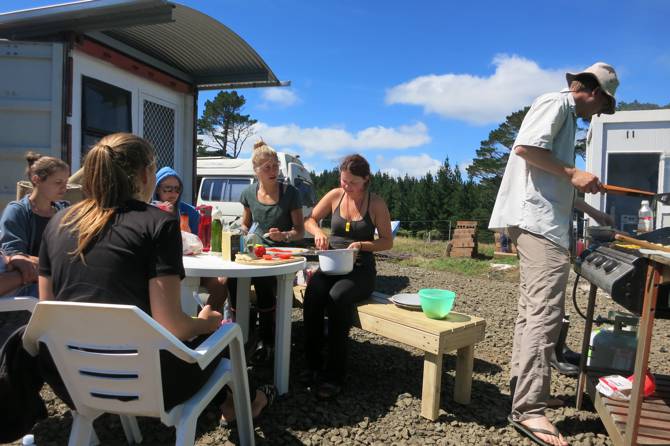
Volunteers will live among nature in an off the grid, ecologically friendly camp. The common structures of the camp (kitchen, showers, dining room) are made from recycled shipping containers. They do not have electricity or running water (except on occasions where generator will be turned on for a short time for hot showers).
The accommodation for volunteers consists of a small cabin with two bunk beds each (men and women have separate cabins), or you can upgrade to an incredible tree tent for a small fee. We only host up to 8 volunteers at a time to ensure enough space for all.
Wifi
There is no wifi available for use as we do not have electricity. Phone signal for internet and calls is generally strong in the common areas for these providers: Telecom, Vodafone, Skinny, and 2degrees. There is no connection in the forest (and we like it that way).
Food
Most dietary restrictions can be catered to if we are notified before you come. We drink filtered rain water, eat herbs from our own garden, and have mostly organic meat, cheese and butter that will be made by you. Feel free to bring any additional snacks or special foods yourself, but only goods that do not need refrigeration.
Alcohol, drugs, and smoking
The possession and consumption of alcohol and drugs is not permitted within the sanctuary.
Due to the risk of fire, we cannot accept participants that smoke (this includes vaping).
Requirements
- Minimum age is 20 for Male and 18 for Female participants
- We need able-bodied, healthy volunteers who can live and work in primitive camping settings. You should be able to walk 10km a day
- Due to the high energy required to participate in our program, we are unable to accommodate those on a vegan diet.
- Due to the risk of fire to the forest, we are not able to host participants that smoke.
- Minimum commitment is 10 weeks
- A background in ecology, biology, zoology, conservation science, or a related discipline is advantageous but not required. What matters most is a genuine commitment to conservation fieldwork and the ability to live and work in a remote, off-grid environment for an extended period.
- Full medical insurance
- Liability insurance (minimum $5000)
- Strong teamwork skills
- Clothes for rainy/chilly weather (even in the summer)
- Warm sleeping bag and gumboots (also known as rubber boots or Wellingtons)
- Please bring a supply of any necessary medications that will cover your entire stay. The nearest medical clinic is 50 km away.
- Necessary vaccinations
- Necessary flights & visas (most nationalities will be fine with a tourist visa).
Costs
$4300 USD for the first ten weeks + $330 for each week thereafter
Included in the internship fee:
- All accommodation (on-site at the sanctuary, separate cabins by gender)
- Three meals daily, prepared communally
- Full field training and equipment access (thermal imaging, acoustic recorders, drones, telemetry, GPS and VHF radio)
- Weekly mentor sessions and skills log
- University placement letter from a named supervisor, suitable for submission to European and North American university placement offices
- Certificate of completion detailing species worked with, equipment operated, and DOC methodologies applied
- Weekly Kauri Coast excursions
What’s not included:
Flights, snacks, insurance, visas (if applicable), airport pickup/drop off and vaccinations. Full assistance will be provided in getting all these arranged if you choose our Premium Support.
Premium Support Upgrade
We understand there’s a great deal to plan and organise for your trip. When booking a Placement, many of our participants choose to purchase our Premium Support Upgrade to benefit from the expertise, knowledge and experience of our Project Coordinators.
We can provide the personal advice you need to ensure your trip is organised with excellence and planned with efficiency; ensuring the very best experience possible. Read more about how we can help you.
New Zealand
Note: Map coordinates are approximate
Past Participants Say